
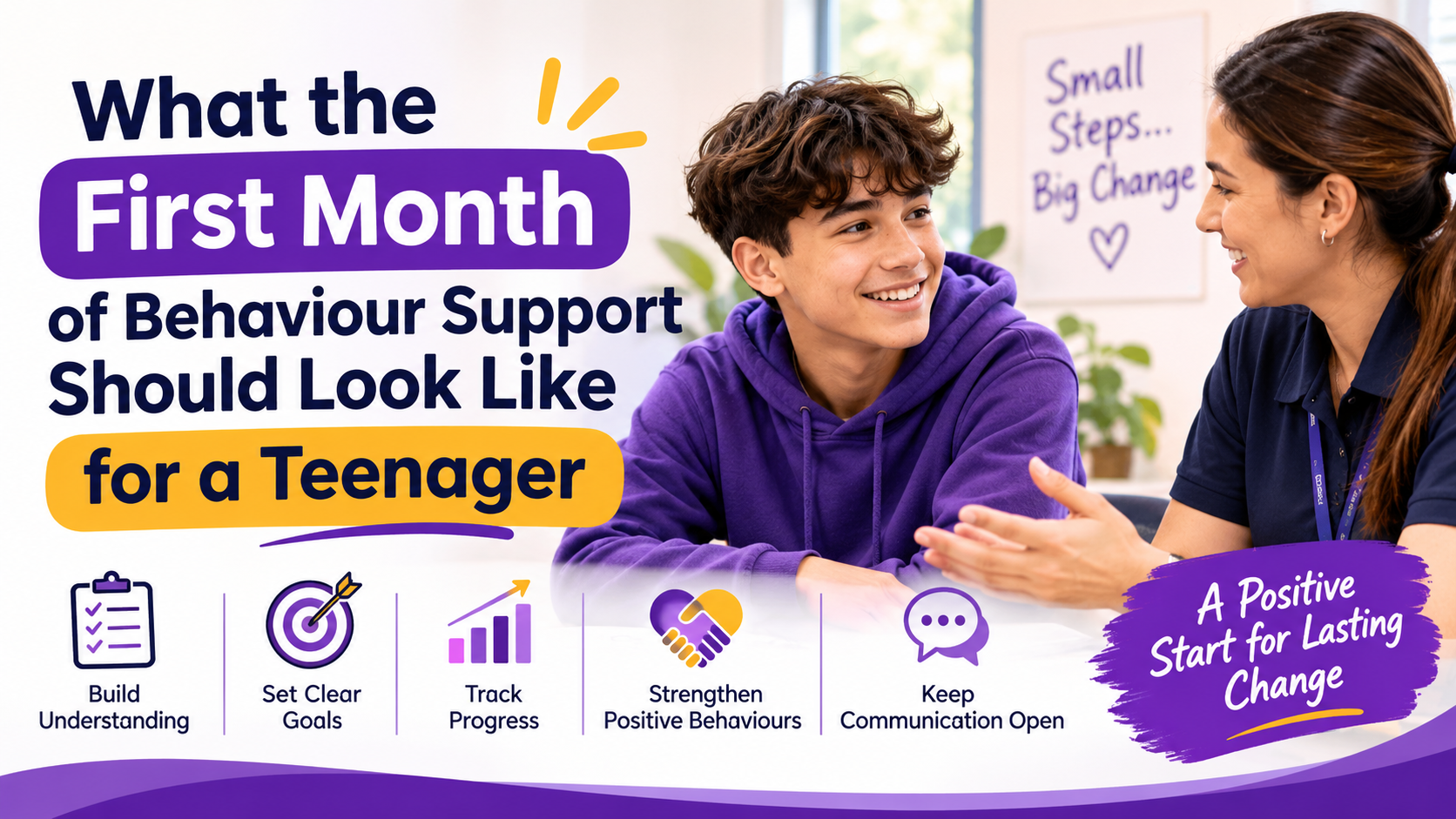
Most behaviour support gets tested in a kitchen at seven at night. A tired parent, a teenager who's had enough, and the hardest 10 minutes of the day. I write every plan for that moment. So the first month is really about getting ready for it.
If your young person has just been referred for positive behaviour support (PBS) through the NDIS, you're probably wondering what happens next. I've spent about 8 years on the frontline in disability, youth services and out-of-home care, and now, at Supporting Communities Australia in Liverpool, I work only with young people aged 12 to 20. Teenagers are my thing. Here's what I think a good first month looks like, what your practitioner should be doing, and how you'll know it's on track.
Week 1: referral, intake and the first conversation
The first few days are about the basics. Your practitioner checks what's being asked for, how it's funded and who needs to give consent. Behaviour support is paid from the Behaviour Support budget in your young person's NDIS plan (called 'Improved Relationships' on older plans). Have the plan handy. No plan yet? My free NDIS access guide walks families through applying, step by step.
Then comes the first proper conversation, usually with you. When I meet a new family, I ask about strengths before I ask about the hard moments. What does a good day look like? How does your young person show you they're upset? What are they into? Drawing, gaming, music, a footy team, and a YouTube channel – they never stop talking about. I write all of it down. Every bit. It matters later.
You should leave that first chat feeling heard. You should also know what the next few weeks hold.
Weeks 1 to 2: rapport comes first.
With teenagers, nothing sticks without buy-in. So my early sessions mostly look like getting to know each other. A walk. A game. A long chat about the thing they care about most.
I know this can feel slow when you're exhausted and want things fixed now. Fair enough. But a teenager who doesn't trust me won't show me what's really going on, and then the plan gets built on guesses. Rapport is the stabiliser. Skill is the objective.
Your young person's voice has belonged to this from day 1. They're the experts on their own life. Ask your practitioner how your young person will be involved in their own plan. In my practice, I'm building a way for young people to help write their own version through drawing and story. It's still early.
Weeks 2 to 4: starting to understand the behaviour
Every behaviour has a job. Usually it's getting something, getting away from something, or feeling okay again. Working out that job is called a functional behaviour assessment. It's the real clinical work.
In the first month, your practitioner will usually start gathering:
- Conversations with you, your young person and, with your consent, the school and support workers.
- The reports you already have, like diagnosis reports and school letters.
- Observation at home, at school or out in the community.
- Simple data. Often just short notes on what happened before, during and after a hard moment.
I also check health early. Pain, poor sleep or a medical issue nobody's picked up can drive behaviour. I want that ruled in or out before anyone decides what a behaviour is for.
The full assessment usually takes longer than 4 weeks. That's normal. By the end of month 1, you should see your practitioner forming ideas and talking them through with you.
If things are urgent: the interim plan
Sometimes there's an immediate need. Safety at home or in a school place under pressure. In that case, the NDIS Quality and Safeguards Commission's rules require an interim behaviour support plan within 1 month of the practitioner being engaged. It covers the basics: keeping everyone safe, changes that take the pressure off, and calm ways for adults to respond in the moment.
The comprehensive plan, built on the full assessment, follows within 6 months.
Common goals in the first month
Early goals are small and practical. For example:
- Getting through the morning routine with fewer battles.
- A shared plan for what everyone does when things start to build.
- One change at school that takes the edge off the hardest moments.
- Help your young person name what's going on for them, in their own words or pictures.
Big change takes longer. Months, usually. I'd rather you see the hardest part of the day get a little easier in month 1 than get promised a miracle.
How progress is tracked
You don't need a spreadsheet. A good data plan is one your family can keep up with on a normal week. I use a 1-minute log families can fill in on their phone after a hard moment. Some families just tally good mornings on the fridge.
Your practitioner should explain what they're tracking and why, then show you what it's telling them. If it's too much for your household, tell them. The plan should bend to fit your life.
What you can do to help
- Gather the reports and letters you already have.
- Jot down 2 or 3 real examples of hard moments: what happened before, during and after.
- Tell your practitioner what's worked before and what hasn't.
- Be honest about what you can manage. A plan that fits your real week beats a perfect one nobody can run.
Signs the first month is going well.
- Your young person has met the practitioner and isn't dreading the next visit.
- You understand what's happening and what comes next.
- Your practitioner is asking more questions than they're answering.
- If there was an urgent need, you have an interim plan.
If a finished plan lands in week 1 with no real conversation behind it, ask questions. Good behaviour support takes time to get right. The first month is where that time goes.
Yosmerys Aparicio Cuencas is an NDIS behaviour support practitioner and the founder of Supporting Communities Australia. She works with young people aged 12 to 20 across Western Sydney, South West Sydney and the Illawarra.
Share on